Winning More and Losing Everything: The Ugly Math Behind Bankroll Blowups
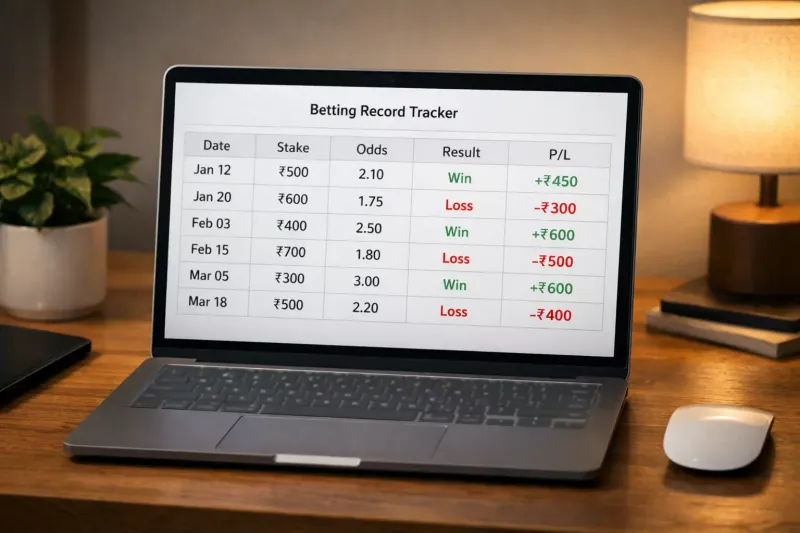
Photo: sports bettor stressed looking at bankroll spreadsheet with charts, via indiabettips.com
Let's say you've done everything right. You've studied the lines, tracked your bets, and you're sitting at a 56% win rate against the spread. That's legitimately good. Most recreational bettors never sniff those numbers. By almost any measure, you should be printing money.
So why is your bankroll down 30%?
Welcome to what sharp bettors quietly call the volatility tax — a concept that sounds academic until it's eating your rent money. The brutal truth is that accuracy alone doesn't protect you. The way you bet matters more than whether you're right, and for most players, the way they bet is quietly destroying them even when their picks are solid.
The Win Rate Illusion
Here's where bettors get tripped up. They treat sports betting like a simple math problem: win more than you lose, collect profit. But that model ignores the single most destructive force in gambling — variance.
Variance doesn't care how smart you are. It doesn't care that you spent three hours breaking down injury reports or that you've got a 57% hit rate on SEC road underdogs. Variance is the statistical reality that even a coin weighted toward heads will sometimes flip tails ten times in a row. And when that cold streak hits, the size of your bets determines whether you survive it or blow up.
Consider two bettors. Both hit 55% of their picks over a season. Bettor A flat bets 2% of their bankroll on every game. Bettor B bets 5% on their "locks" and 1% on their "leans." Over 500 bets, Bettor A builds a modest but steady profit. Bettor B? Their results swing wildly — sometimes ahead by 40%, sometimes in a hole they can't climb out of. Same win rate. Completely different outcomes.
That's the volatility tax in action.
Why Your Best Bets Are the Most Dangerous
This is the part that feels counterintuitive, so stick with it.
When bettors feel confident — when they've got what they consider a premium play — they size up. Maybe they normally bet one unit, but this week's college football spread feels like a gift, so they go three units. This is almost universal behavior. And it's almost universally destructive.
Here's why: the games you're most confident about are also the games where you've likely consumed the most information, built the most narrative, and convinced yourself most thoroughly. That confidence isn't a signal of actual edge — it's often a signal of cognitive bias. You've talked yourself into something.
Meanwhile, the variance on that game is identical to every other game. A key injury, a bad call, a fumble at the one-yard line — none of that cares about your conviction. So what you've actually done by sizing up is increased your risk exposure on a bet that carries the same statistical uncertainty as any other. When it loses — and eventually it will — you've taken three times the hit for the same odds.
Sharp books have known this for decades. They don't fear bettors who pick winners. They fear bettors who manage risk. Those are two very different skill sets.
The Downswing Nobody Plans For
Every bettor knows losing streaks exist. Almost no bettor actually builds their bankroll to survive one.
Run the numbers on a 55% bettor using standard -110 juice. Even at that win rate, a 10-game losing streak is statistically inevitable over the course of a full season. It's not bad luck — it's math. And if you're betting 5-10% of your roll per game, a 10-game skid doesn't just hurt. It can cut your bankroll in half or worse.
Now here's where it gets really ugly. After a bad run, most bettors don't tighten up. They chase. They increase bet size trying to recover losses faster. They start hunting action instead of value. The downswing that should have been a manageable dip becomes a full account burial.
The Kelly Criterion — a position-sizing formula used by professional gamblers and investors alike — actually addresses this directly. The math behind Kelly says that even if you have genuine edge, overbetting that edge guarantees long-term ruin. You can be the sharpest bettor in the room and still go broke if your unit size is too aggressive relative to your actual edge percentage.
Most recreational bettors are running two to four times the Kelly-optimal bet size on every single play. They don't know it. But the house does.
What Uncomfortable Discipline Actually Looks Like
The bettors who survive long downswings — the ones who are still in the game three years from now — share one common trait. Their bet sizing feels boring, even embarrassing, compared to the action they want to take.
A disciplined approach looks something like this:
Flat betting or near-flat betting. Pick a unit size — somewhere between 1% and 3% of your total bankroll — and stick to it regardless of confidence level. Your "best bet of the week" gets the same unit as your secondary plays. This feels wrong. It is also correct.
Hard stop-loss limits. Decide in advance what a bad week looks like and what you'll do about it. If you drop 10 units in a week, you reduce bet size the following week. No exceptions, no rationalizations. The rule exists specifically for the moments when you don't want to follow it.
Separating confidence from sizing. Track your high-confidence plays separately. After 100 games, check whether your "locks" actually hit at a higher rate than your regular plays. If they don't — and for most bettors, they won't — you've got data to justify dropping the variable sizing entirely.
Rebuilding after drawdowns. If your bankroll drops by 20%, your unit size should drop proportionally. Betting the same dollar amount on a smaller roll means you're actually increasing your percentage risk. That's the math that turns a manageable losing streak into a wipeout.
The Edge Nobody Wants to Sell You
Sports betting content is dominated by picks, systems, and angles. Everyone's selling the next edge. But the actual edge — the one that separates long-term survivors from the majority who flame out — is almost entirely about position sizing and bankroll discipline.
You can subscribe to every tout service in the country, nail 58% of your plays, and still lose money if your bet sizing is sloppy. Conversely, a 53% bettor with iron discipline and flat unit betting can build a sustainable profit over time.
Variance is the house's silent partner. It doesn't need you to pick losers. It just needs you to bet big when you're wrong and survive the swings by the thinnest possible margin. The volatility tax is real, it's mathematical, and it collects from bettors at every skill level.
The only way to beat it is to bet smaller than feels right, stay consistent when it's boring, and trust the math instead of the moment. That's not the advice anyone wants. It's the advice that actually works.